

Garett Harper

I started on the technical side: a computer information systems degree, then years as a developer and analyst building web platforms for city and state governments. That early grounding taught me how systems actually get built, not just how they get designed.
In 2018 I stepped into product ownership for Eastern Kentucky University's digital ecosystem. My official title was Senior Web Developer, but I functioned as de facto product manager with final approval authority for web initiatives touching 16,000+ students and families. I grew that digital product function from one person to eight and built the governance framework the university still runs on today.
From 2023 to 2026, I led consumer-facing product work for The E.W. Scripps Company, owning strategy for its entertainment brand portfolio (ION, Grit, Laff, Bounce, Court TV) and app development across its local news products, spanning iOS, Android, Roku, Fire TV, Apple TV, Android TV, and web.
Where I've worked and what I moved forward while I was there.
- Own consumer product strategy for Scripps' entertainment brand portfolio (ION, Grit, Laff, Bounce, and Court TV) across web, mobile, and connected TV, with app development ownership extending to the Local News portfolio (60+ stations), prioritizing by user research, analytics, and business objectives.
- Led cross-functional teams across engineering, design, brand, and operations to ship features including dynamic scheduling APIs, enhanced video playback, and content discovery improvements.
- Reduced tech debt and increased team efficiency by unifying three brands (five sites, including ION's three-site family) onto one CMS, while the redesigned ION-branded sites specifically saw 28% YoY traffic growth and drove 74% YoY growth in a key revenue metric.
- Served as de facto product manager with final approval authority for web initiatives affecting 16,000+ students and families.
- Authored and secured adoption of a Web Governance Policy establishing ownership, decision rights, and quality standards across 50+ departmental stakeholders.
- Grew the digital product function from 1 to 8 FTEs (700%) and improved prospective student conversion 15% through a rebuilt information architecture.
- Assumed full ownership of legacy web systems after the senior developer's departure just three months into the role, with no formal handoff.
- Documented CMS and accessibility standards, cutting support requests 40% by enabling independent publishing.
- Translated user requirements into actionable user stories and acceptance criteria for the development team.
- Developed web governance strategies and built consensus on website direction across 70+ city departments.
Products I've shipped: the problem, the approach, and what happened.
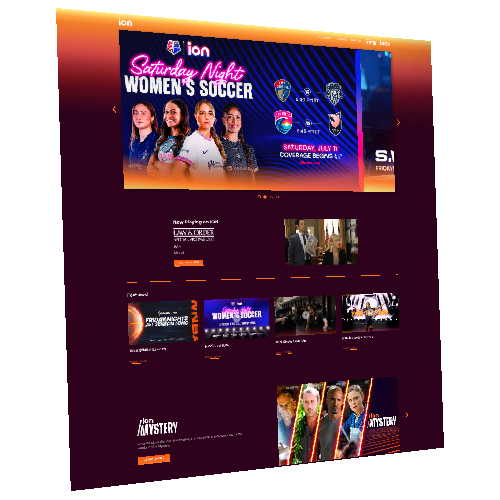
- Problem: ION's family of sites (ION, ION Plus, ION Mystery) were each maintained separately, alongside standalone sites for Grit and Laff, creating duplicated tech debt and inconsistent user experiences across brands under common ownership. Bounce remained on its own legacy platform, slated for migration next.
- Approach: Led the consolidation of five previously separate sites, spanning three brands (ION's three-site family, plus Grit and Laff), onto a single CMS, pairing the platform migration with a user-centered redesign. Prioritized features using Google Analytics, Parse.ly, and Conviva data, and aligned brand and marketing stakeholders around one shared roadmap across the affected brand.
- Result: Consolidated five sites (ION, ION Plus, ION Mystery, Grit, and Laff) onto one CMS, reducing tech debt and increasing team efficiency, with Bounce's migration next. The redesigned ION-branded sites specifically saw 28% YoY traffic growth and drove 74% YoY growth in a key revenue metric.
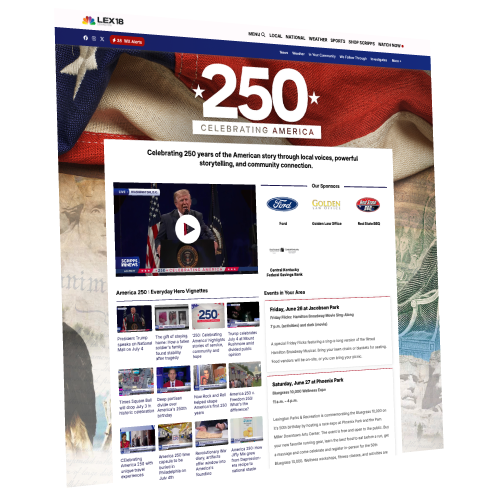
- Problem: America 250 was a tentpole initiative for Scripps' affiliate network, anchored by dedicated broadcast programming for the Fourth of July — but the affiliate sites had neither dedicated landing pages nor any way to surface local events, leaving affiliates with no way to capture engagement around the tentpole at scale.
- Approach: Built the underlying theme, landing pages, and editorial workflow across all affiliate stations, integrating an AI-powered event-discovery tool (built by our AI lead) to populate local market listings tied to the broadcast programming, and coordinating with sales and editorial teams to launch the sponsor placement initiative across the affiliate network.
- Result: Launched dedicated landing pages and event listings across 60+ affiliate stations, contributing to nearly $2M in incremental revenue.

- Problem: The university's digital presence had no clear product ownership — no governance model, no shared decision rights across 50+ departments, and legacy systems limiting growth.
- Approach: Authored and won adoption of a formal Web Governance Policy, moved the university onto modern, scalable platforms, and convinced administration to make a significant investment in the web team — building it from the ground up.
- Result: Grew the digital product function from 1 to 8 FTEs (700%), improved prospective student conversion 15%, and cut bounce rate 10% through a clearer information architecture — while formalizing standards that streamlined expectations and efficiency across departments.
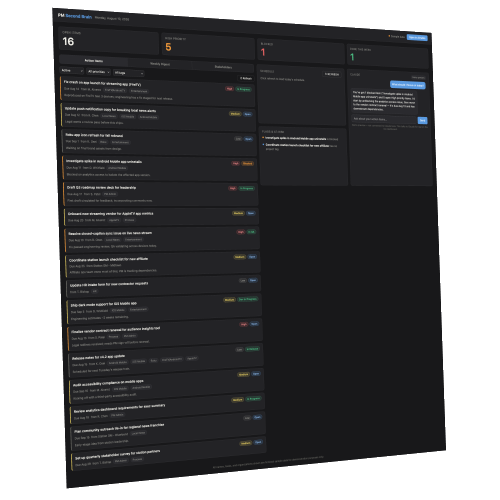
- Problem: Everyone talks about AI "reshaping product workflows." I wanted to actually test that claim on my own job, not in theory. Product work generates a constant stream of unstructured input — meeting decisions, email requests, chat threads, ticket comments — and the real question wasn't whether AI could summarize any one of those. It was whether an AI agent could be trusted to run the whole intake pipeline: pull the signal out reliably, structure it consistently, and flag what actually mattered, week over week, without me re-checking its work line by line.
- Approach: I built this in direct collaboration with Claude, an AI agent, rather than using AI as a one-off writing tool. That partnership shows up at two levels:
- Building it: I worked with Claude to design the data model, build out the triage logic (priority, deadline type, status, source), and stand up the dashboard — describing what I needed and reviewing what it produced, the same way I'd work with an engineer.
- Running it: The system itself runs on a recurring cadence of AI-assisted triage sessions that ingest meeting transcripts (via Krisp), email (Gmail), team chat (Teams), and ticket comments (Jira, Wrike) — extracting concrete action items and normalizing them into one structure: priority, deadline, status, project tag, and a link back to the source.
- Result: The output is a system that replaced manual tracking across six disconnected channels with one prioritized queue — but the more interesting result is what it proves about how I work: I can direct an AI agent through a real, multi-step technical build (not just a prompt-and-done task), and I trust AI enough to let it run a live operational process I depend on daily, because I designed the checkpoints where I stay in the loop.
- Try It: a live demo with sample data is at demo.garettharper.com — the interface and data model match the real system; the chat panel is a non-functional preview (labeled as such in the demo), and the data shown is fictional.

- Problem: As a band booster dad, I saw how much inefficiency was baked into how a 200+ family volunteer organization ran, no centralized parent/alumni contact list, fragmented communication dependent on Facebook's algorithm, manual financial tracking with no dedicated tooling, among other needs.
- Approach: Pitched a plan to modernize the organization's systems and was appointed to a newly created Digital Transformation Chair role to lead it. Rebuilt the website and migrated to Google Workspace for Nonprofits, launched a centralized email newsletter (Sendy) to reach families outside Facebook's reach, and implemented Presto Assistant to run payments and core financial operations.
- Result: Rebuilt the organization's core infrastructure, website, communications, and financial tooling, replacing fragmented, ad hoc processes with systems built to scale. Implementation is ongoing, including implementation of a CRM and additional automation currently in progress.
Between leading concessions volunteers and coordinating our Derby fundraiser, our band program's 200+ kids feel like mine too. That work helped raise over $70K this year, but honestly, it was about showing up for these kids in support of what they love.
One kid in college, one in high school, one in middle school, and when you throw in 200+ kids in the marching band, chaos is putting it lightly. Turns out that's just stakeholder management with better snacks!
Currently completing Google's AI Professional Certificate, because ten years in, there's always more to learn. Half of what I learned building products in 2018 doesn't apply anymore, and AI is quietly rewriting the other half